
Water stains on a ceiling tile are easy to ignore until the bucket under them fills up. On a commercial flat roof, the spot where water shows up inside is often nowhere near where it got in. That’s why smart flat roof repair in Columbus, IN starts with tracing the source, not just treating the ceiling stain.
Below, we cover what a repair can fix, which methods fit which roofs, why drains and flashing need attention, where a patch stops being enough, and how completed repairs should be checked. Outdo Commercial Roofing serves commercial buildings in Indiana. Building owners can also explore our information about flat roof repair in Evansville, IN.
Why Columbus Flat Roofs Wear Out
Factories, warehouses, distribution centers, retail strips, offices, schools, and churches across Bartholomew County depend on flat roofs. Many of these buildings have large roofs with rooftop units, vents, and pipes poking through.
Our weather is tough on them. Winter brings freeze and thaw cycles that can open small gaps wider. Spring and summer bring heavy rain, strong storms, and sometimes hail. Over time, all of that can show up as leaks.
What Kind of Damage Can Be Repaired?
More than most people think. A lot of commercial flat roof repair work comes down to small problems in one area. Those can often be fixed without replacing the whole roof, although damaged roofing or wet insulation may need localized removal.
Common problems include seams that have pulled apart where two roof sheets meet. Cracks show up on older roofs. Punctures can occur on roofs with frequent service traffic or after impact damage. Blisters, the raised bubbles on the surface, need assessment; some can be monitored, while damaged ones may require repair.
Then there’s the stuff around the edges. Dried-out sealant, loose metal trim, and cracked boots around pipes are common leak sources.
Picking the Right Repair Method
A patch only holds if it matches the roof under it. Put the wrong product down and it may peel off by next spring.
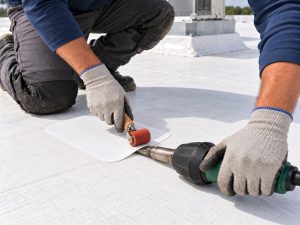
On TPO and PVC roofs, repairs commonly involve heat-welding a compatible patch over the damage after proper surface preparation. The patch must match the membrane type. EPDM, the black rubber kind, typically gets cleaned, primed, and repaired with compatible tape or patch materials. Modified bitumen roofs need repairs suited to their specific system, which may involve cold-applied, self-adhered, or heat-applied materials. Older tar and gravel roofs can require moving the gravel aside, removing damaged layers, and rebuilding the affected area.
Coatings can be a good choice too, but only for a suitable roof after necessary repairs. A coating over an untreated open seam just hides the problem for a while.
Why Drains Need Checking
Flat roofs aren’t really flat. They have a slight slope so water runs to drains, scuppers, or gutters. If that water has nowhere to go, it sits and can increase the risk of leaks.
A repair assessment should consider how water leaves the roof. Are the drains full of leaves? Is the strainer basket missing? Are the scuppers clogged? Is there a low spot still holding water two days after a storm?
Clearing a blocked drain can reduce backed-up water, but any damaged roofing or drain flashing still needs attention. Patching the roof while leaving a drainage problem unresolved can lead to recurring trouble.
Then Look Closely at the Flashing
Flashing seals the roof where it meets a wall, a vent, an AC unit, or the roof edge. These spots experience movement as the building heats up and cools down, making them important places to inspect.
Look for metal pulled away from the wall, screws that have backed out, cracked sealant, and split pipe boots. If water is getting behind any of it, the repair may require resealing, replacement, or rebuilding the flashing detail.
Sometimes water is already pouring in and you can’t wait for a full assessment. Then the first priority is protecting people and limiting further damage where it is safe to do so. See our guide, All About Emergency Commercial Leak Repair, for more about the initial response. Once conditions allow, a full assessment helps identify the cause and the permanent repair needed.
When a Patch Isn’t Enough
A spot repair fixes a spot. It can’t fix a roof that’s worn out from end to end.
If you have leaks in several places, soft areas, or material that is brittle and shrinking at the edges, a patch may not solve the underlying problem. Roof age is another factor, but being more than 20 years old does not automatically mean replacement is needed. Rusted or rotted decking requires separate attention before the roofing above it is repaired.
Wet insulation is the problem many owners don’t know about. Sealing the top does not dry the layers below. Wet insulation loses thermal performance and can contribute to deterioration of surrounding materials. When moisture affects a large area, replacing a section or the whole roof may make more sense than repeated patches. Suspected hidden moisture may require testing to confirm its extent.
The project scope can also affect permit requirements. Confirm those requirements with the local building office and identify responsibility for permits in the contract before work starts.
How Completed Repairs Should Be Checked
Finishing the repair is only part of the job. The completed work also needs checks suited to the roof system and repair method.
Heat-welded seams should be checked after cooling using the membrane manufacturer’s recommended procedure, which commonly includes seam probing. Patches, flashing, and sealant details need a visual check for proper installation. Controlled water testing may be appropriate in some situations, provided it can be done safely without causing additional damage.
Drainage checks and before-and-after photos can also help document the work. The proposal should identify which checks and records are included. After the next significant rain, monitor the previously affected interior area and report any renewed leakage.
Need Commercial Flat Roof Repair in Columbus?
If your commercial roof is leaking, contact Outdo Commercial Roofing to discuss an inspection and repair options. The roof’s condition, material, drainage, and extent of damage help determine whether a localized repair is suitable.
Building owners researching flat roof repair in Evansville, IN can use the same considerations when comparing repair proposals: compatible materials, clear repair details, and appropriate checks of the finished work.
Call Outdo Commercial Roofing at 574-536-2823 to discuss your commercial flat roof in Columbus, IN. For an urgent leak, call to confirm current response availability.
Frequently Asked Questions
1. How much does flat roof repair cost in Columbus, IN?
The price depends on a few things: how big the damaged area is, what type of roof you have, and how easy it is to reach. Rebuilding flashing around a rooftop unit generally costs more than repairing a small puncture. Wet insulation that needs to be removed and replaced also adds to the cost. An inspection helps establish the scope for a written estimate.
2. How long will a flat roof repair last?
A repair done with compatible materials and proper methods can last for years. It depends on the condition of the roof around it and whether water drains properly. Getting the roof checked once or twice a year helps identify new problems early.
3. Can you fix a flat roof in the winter?
Some repairs can be completed in cold weather when conditions meet the roofing manufacturer’s requirements. TPO and PVC patches may be heat-welded in suitable winter conditions, with adjusted settings and test welds. Adhesives, primers, sealants, and coatings have product-specific application limits. When conditions prevent a lasting repair, temporary protection may be appropriate until permanent work can be completed.
4. Should I repair my flat roof or replace it?
If the trouble is in one or two spots and the rest of the roof is sound, a repair usually makes sense. Widespread deterioration, extensive wet insulation, or repeated leaks may favor replacement. An inspection, with additional testing where needed, helps establish which option is appropriate.
5. Is it normal for water to sit on a flat roof?
Some water may remain immediately after rain, but water still standing about two days later deserves attention. Persistent ponding adds weight and can contribute to roofing problems. Blocked drainage, low spots, or other design and structural issues may be involved.
6. Will my insurance pay for flat roof repair?
Coverage depends on your policy, the cause of damage, and the insurer’s assessment. Contact your insurance provider about your specific situation. Document visible damage from a safe location and keep repair records, without delaying necessary steps to protect people and limit further damage.