

A new TPO roof is a big investment for any business. You want it to keep water out, handle storms, and provide dependable service. TPO can offer those benefits when the system is properly selected, installed, and maintained.
The strength of TPO roofing systems depends on more than a reinforced membrane. Reflective white products can reduce solar heat gain, but the sheet is just one piece. Attachment, seam welding, flashing, and drainage all affect how the complete roof performs.
Below, we walk through each key piece of a TPO roof in plain words. You will learn what good work involves and what to ask before you hire. Have a question now? Call Outdo Commercial Roofing at (574) 536-2823.
Choosing the Right Membrane
Every TPO roof starts with the membrane. White is a common finish, though other colors are available. Reinforced TPO membranes contain an internal fabric layer, called a scrim, that provides added strength.
Sheets come in different thicknesses. Thickness is one factor in durability, but it does not determine service life, hail performance, or resistance to rooftop traffic by itself.
When comparing products, consider:
- The manufacturer’s approved roof assemblies and performance ratings
- The expected exposure and project requirements
- Rooftop equipment and service traffic
- Walkway protection where regular access is needed
- Warranty eligibility and maintenance requirements
Before signing, ask for the exact product name and thickness in writing. The proposed assembly should meet the requirements of any specified warranty.
How the Sheet Is Held Down
Strong winds can put substantial uplift forces on a roof. The membrane and underlying components need an attachment system suited to the building.
Three common ways to attach TPO are:
- Mechanically attached: Fasteners and plates secure the membrane according to an approved layout, commonly within laps covered by the adjoining sheet. Perimeters and corners may require additional attachment.
- Fully adhered: The membrane is bonded to an approved substrate with compatible adhesive. Surface preparation and application conditions must meet the product requirements.
- Induction-welded: The membrane is bonded to compatible coated plates using specialized equipment. The plates are mechanically secured beneath the membrane, reducing fastener penetrations through the sheet itself.
The method should suit the deck, roof assembly, building height, and wind exposure. Ask why the proposed system is appropriate for your property.
Sealing the Seams
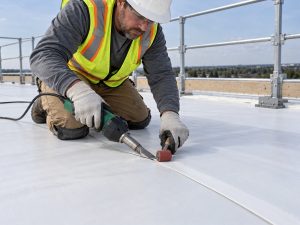
TPO comes in rolls, so adjoining sheets need watertight seams. Field seams are typically joined with hot air, which fuses compatible membrane surfaces together.
A reliable weld needs clean material and suitable heat, pressure, and travel speed. Insufficient heat can leave a weak bond, while excessive heat can damage the membrane.
Test welds should be made and evaluated according to the manufacturer’s instructions before production welding and as conditions change. Finished seams should be checked after cooling with the specified inspection method, including seam probing where required. Defects need correction using an approved repair procedure.
Why One Crew for the Whole Job Helps
Roof projects can involve several trades and stages. Clear responsibility matters when removal, insulation, membrane installation, and edge-metal work are coordinated.
For owners comparing full service TPO roofing proposals, the scope should identify who handles the inspection, tear-off, deck repairs, insulation, membrane, flashing, and cleanup. A named point of contact helps coordinate the work, whether it is completed by one crew or several qualified teams.
Confirm who is responsible for each stage and what warranties apply to the finished system.
Flashing Pipes, Vents, and Rooftop Units
Openings and transitions need careful flashing. Common details include:
- Plumbing vent pipes
- HVAC and exhaust curbs
- Skylights and roof hatches
- Gas-line and electrical-conduit penetrations
Each detail needs compatible flashing suited to its shape and construction. Approved preformed boots and corners can simplify suitable details. Field-fabricated flashing is also used where permitted by the selected system.
Curb and wall flashings need appropriate height, secure terminations, and approved connections. Pipe boots require the top seal and clamp specified by the manufacturer. These details must account for movement and water exposure rather than rely on sealant alone.
Moving Water Off the Roof
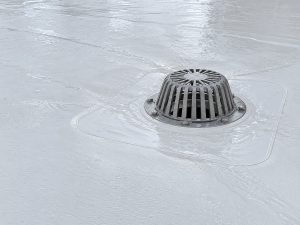
A low-slope roof still needs a drainage design that directs water toward suitable outlets.
Persistent standing water adds load, collects debris, and deserves evaluation. Drainage performance should be assessed against the roof design, applicable requirements, and the selected system’s instructions.
Drainage improvements may include:
- Tapered insulation that guides water toward drains
- Crickets that direct water around curbs and other obstructions
- Appropriately designed drains, scuppers, gutters, and overflow routes
Where nearby trees shed leaves onto the roof, drainage outlets may need more frequent attention. Fall checks are useful, alongside the manufacturer’s maintenance schedule and inspections after significant storms.
What TPO Offers vs. What the Crew Controls
TPO products offer properties such as flexibility, reinforcement, and, for suitable finishes, solar reflectance. Actual performance varies by product and roof assembly.
The completed roof also depends on design, substrate condition, fastening, seam welds, flashing, drainage, and maintenance. Even a suitable membrane can develop problems if these details are neglected. Energy savings and service life should not be treated as automatic results of choosing TPO.
Talk to a Local TPO Roofing Team
If you are planning TPO roofing in New Albany, IN, contact Outdo Commercial Roofing to discuss your project. Ask about the inspection scope, drainage and penetration details, available system options, and what the written proposal includes.
Call (574) 536-2823 to arrange a commercial roof assessment.
Frequently Asked Questions
1. How much does TPO roofing cost in New Albany, IN?
The price depends on roof size, membrane selection, insulation, attachment, access, and the condition of the existing assembly. Tear-off, deck repairs, drainage changes, and numerous penetrations can increase the scope. An assessment and written proposal help establish the project price.
2. Can TPO roofing be installed in cold weather?
It may be possible when conditions meet the selected system’s requirements. Welding settings, test welds, adhesive limits, storage, and substrate conditions all need attention. Changing the attachment method requires an appropriate approved design; it is not simply a substitute for unsuitable weather.
3. How long does it take to install a TPO roof?
The schedule depends on roof size, complexity, removal requirements, deck repairs, access, and weather. Ask for a project-specific timeline and an explanation of conditions that could delay the work.
4. Can a TPO roof be repaired, or does it need replacing?
Localized punctures, tears, and seam defects may be repairable using compatible materials and approved preparation and welding methods. Widespread deterioration or wet insulation requires a broader assessment before choosing repair, restoration, or replacement.
5. Will a TPO roof lower my energy bills?
A reflective white TPO membrane can reduce solar heat gain. Its effect on energy costs depends on insulation, climate, building use, equipment, and the existing roof. Savings are not guaranteed.
6. How often should a TPO roof be inspected?
Spring and fall inspections are a useful baseline, along with checks after significant storms. Follow the manufacturer’s maintenance requirements and adjust the schedule for rooftop activity, debris, and roof condition.