

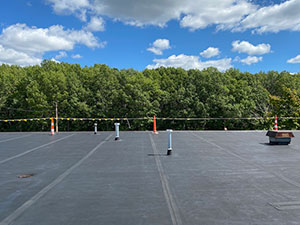
Commercial roof inspection should give a building owner enough documented evidence to decide whether the next step is routine maintenance, a targeted repair, additional investigation, or a broader replacement assessment. A useful inspection is more than a visual walk-through because the report should connect observed conditions to specific locations, priorities, limitations, and follow-up actions.
Outdo Commercial Roofing provides commercial roof inspection services across Southern Indiana. For owners and facility managers, the most valuable outcome is a clear condition record that separates confirmed defects from conditions that still need testing before a repair or replacement scope is approved.
What a Commercial Roof Inspection Should Evaluate
The inspection should review the roof surface, seams, flashing, penetrations, drainage, insulation concerns, deck indicators, and previous repair areas. The goal is to document visible conditions and identify where additional investigation may be needed.
Membrane and Surface Condition
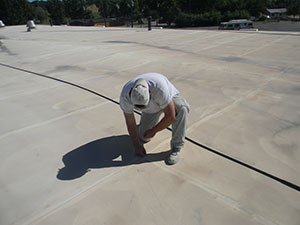
Membranes and other roof surfaces should be checked for punctures, open seams, blisters, cracking, displaced materials, coating wear, and other defects that could allow water into the assembly. The report should identify the location and extent of the observed condition instead of using a general statement such as “roof needs repair.”
Flashing, Penetrations, and Edges
Flashing around walls, curbs, vents, drains, HVAC equipment, skylights, and other penetrations should be checked for gaps, separation, failed sealant, movement, or deterioration. Roof edges and perimeter details should also be reviewed because these transitions often experience different stresses than the field of the roof.
Drainage
Drains, scuppers, gutters, downspouts, and ponding areas should be documented so the owner can distinguish debris or maintenance issues from broader drainage conditions that may require repair or redesign. A roof inspection should not assume that every standing-water area has the same cause.
Insulation and Deck Indicators
Interior staining, soft areas, surface irregularities, or other observations can suggest that moisture or substrate deterioration may be present, but those signs do not establish the full extent of concealed damage by themselves. Additional moisture testing or a targeted opening may be needed before the final scope is set.
What the Inspection Report Should Include
The report is the decision-making document. It should give the owner a usable record of what was found and what remains uncertain. A practical report outline can include:
- Dated photographs: Images tied to the inspection date so future inspections can compare the same locations over time.
- Defect locations: Clear identification of where each issue appears on the roof, rather than a vague list of general concerns.
- Condition description: The observed defect, surrounding material condition, and any visible evidence that the problem extends beyond one location.
- Moisture limitations: A statement explaining how moisture was evaluated and what the selected method can and cannot confirm.
- Prioritized actions: Findings separated into immediate repair, planned maintenance, monitoring, or additional investigation.
- Reinspection triggers: Conditions that should prompt another inspection, such as significant weather, recurring leakage, rooftop work, or a condition identified for monitoring.
Owners should keep these reports with repair records, photographs, warranty information, and maintenance history. Comparing documentation over time can help distinguish a one-time defect from a recurring or expanding condition.
How Thermal Findings Should Be Used
Infrared or thermal imaging can help identify temperature patterns that may be consistent with moisture below the roof surface. Those findings are indicators, not proof of wet insulation or a defined repair boundary. Recent rain, solar exposure, surface temperature, material differences, and other conditions can affect the reading.
If a major repair decision depends on a thermal finding, the suspected area should be confirmed with an appropriate follow-up method, such as moisture-meter readings, core sampling, or another investigation suited to the roof system. The report should distinguish screened areas from confirmed moisture conditions.
How the Report Becomes a Scoped Estimate
The completed report should go to the building owner, facility manager, or other person responsible for approving the work. A contractor can then use the documented findings to prepare a scope that identifies the exact defects being addressed, materials or methods included, exclusions, access requirements, and any condition that could change the work after additional investigation.
This makes it easier to compare maintenance, repair, restoration, or replacement recommendations because the price can be tied back to documented conditions. Outdo Commercial Roofing’s commercial roofing services provide related context for the next steps that may follow an inspection.
When to Schedule the Next Inspection
There is no single inspection interval that fits every commercial roof. Timing can depend on roof age, system type, warranty or manufacturer requirements, maintenance history, rooftop activity, recent repairs, building use, and significant weather. A report should identify any specific condition that needs an earlier follow-up instead of relying only on a calendar schedule.
After severe weather or a new leak, another inspection may be appropriate even if the last scheduled inspection was recent. Outdo’s storm-related commercial roofing guidance provides additional context for post-event review.
Commercial Roof Inspection in Southern Indiana
Outdo Commercial Roofing serves commercial properties across Southern Indiana and can use inspection findings to help owners understand the next maintenance, repair, or replacement decision. Contact the company at (574) 536-2823 to discuss a commercial roof inspection.
Frequently Asked Questions
What should a commercial roof inspection report include?
A useful report should include dated photos, defect locations, condition descriptions, moisture limitations, prioritized actions, and reinspection triggers so the owner can connect findings to the next step.
Can thermal imaging prove that insulation is wet?
No. Thermal imaging can identify temperature patterns that may indicate moisture, but important findings should be confirmed with an appropriate follow-up method before a major repair scope is based on them.
Who should receive the inspection report?
The building owner, facility manager, or other person responsible for approving roof work should receive the report and keep it with maintenance, repair, and warranty records.
How often should a commercial roof be inspected?
The schedule depends on the roof system, age, condition, warranty requirements, maintenance history, rooftop activity, recent repairs, and significant weather. The report should identify any reason for an earlier follow-up.