
PVC roofing can be a strong option for some commercial low-slope roofs, but the membrane name alone does not determine whether it fits the building. Substrate condition, drainage, insulation, attachment method, rooftop activity, detailing, service access, and future repair compatibility all affect how well the system matches the project.
Outdo Commercial Roofing installs and services single-ply roofing across Southern Indiana. Owners comparing PVC with other membrane options can review the company’s single-ply systems while asking how the proposed assembly fits the existing roof and the building’s operating needs.
What Is PVC Roofing?
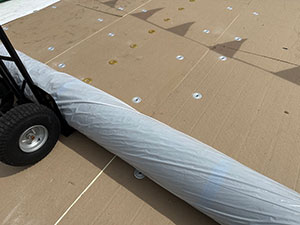
PVC roofing is a thermoplastic single-ply membrane commonly reinforced with a fabric scrim. Sheets are joined with heat-welded seams, creating a continuous membrane when the welding, detailing, and attachment are completed according to the selected system. The complete roof still includes more than the membrane itself, including insulation, cover boards where used, attachment components, flashing, edges, and penetration details.
Is PVC Roofing a Good Fit for the Building?
The table below separates basic suitability questions from headline benefits. A contractor should confirm these items before treating PVC as the preferred system.
| Factor | What to confirm |
|---|---|
| Substrate condition | Whether the deck and materials that will remain are dry, sound, and suitable for the proposed assembly. |
| Drainage | How water reaches drains or edges and whether ponding, blocked drainage, or slope problems need separate correction. |
| Attachment | Whether the membrane will be mechanically attached or adhered and how that method fits the deck and project requirements. |
| Insulation | The type, thickness, condition, and compatibility of the insulation within the complete roof assembly. |
| Rooftop activity | Where technicians regularly walk or stage equipment and whether traffic protection should be part of the design. |
| Detailing | How drains, curbs, penetrations, walls, edges, and transitions will be flashed with compatible PVC components. |
| Service access | How maintenance teams will reach rooftop equipment and repair areas without creating unnecessary membrane damage. |
Seam Welding and Repair Compatibility
PVC seams are commonly heat welded, so future repairs need to match the existing membrane and use compatible PVC repair materials and welding procedures. A patch should not be treated as interchangeable with TPO, EPDM, or another membrane simply because the roofs look similar from a distance.
Before repair work is authorized, the contractor should confirm the existing membrane type, the condition of the surrounding material, how the surface will be prepared, and which compatible flashing or repair products will be used. Repairability also depends on the age and condition of the membrane, contamination, prior coatings, and whether the surrounding material can still be prepared for a reliable weld.
Benefits to Evaluate, Not Assume
Reflectivity: Light-colored PVC membranes can reduce solar heat absorbed at the roof surface. Actual building energy use still depends on insulation, HVAC performance, air leakage, occupancy, weather, and operations, so cooling-cost savings should not be presented as a guaranteed result.
Durability: PVC can provide long service when the complete roof assembly is properly designed, installed, maintained, and repaired. There is no single lifespan that applies to every project because drainage, rooftop traffic, detailing, climate, installation quality, and maintenance all affect performance.
Weather exposure: The membrane is designed for exterior roofing use, but project performance depends on the complete assembly, attachment, seams, flashings, edges, and site-specific conditions rather than the membrane material alone.
Maintenance: A PVC roof still needs inspection and service. Drains, seams, penetrations, flashings, traffic areas, and membrane damage should be monitored as part of the building’s roof maintenance and repair plan.
End-of-life handling: PVC membrane can be recyclable in some programs, but actual recovery depends on the product, condition, local options, contamination, and how the removed material is handled. Recyclability should not be treated as proof of a specific environmental outcome for every project.
What the Contractor Should Confirm Before Installation
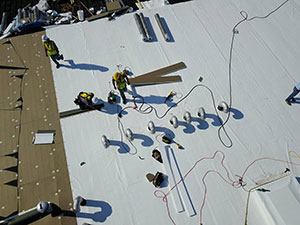
Before installation, the contractor should define the membrane system, insulation, attachment method, seam and flashing details, drainage conditions, penetration work, edge conditions, traffic protection, and important exclusions. The proposal should also make clear which existing materials are being removed or retained and what conditions could change the scope after the roof is opened.
Outdo’s company information provides additional context on its roofing team and service approach. Owners who want a building-specific assessment can use the company’s contact page to discuss whether PVC or another commercial roofing system fits the project.
PVC Roofing in Southern Indiana
A good PVC decision starts with the building, not a list of generic advantages. Confirm substrate condition, drainage, insulation, attachment, rooftop activity, detailing, service access, and future repair compatibility before selecting the system.
Contact Outdo Commercial Roofing at (574) 536-2823 to discuss PVC roofing for a commercial property in Southern Indiana.
Frequently Asked Questions
How long does PVC roofing last?
There is no single service-life number for every roof. Installation quality, drainage, rooftop traffic, climate, maintenance, and repair history all affect how long a PVC system remains serviceable.
Is PVC roofing energy-efficient?
Reflective PVC membranes can reduce solar heat absorbed at the roof surface, but actual energy use depends on the full building and roof assembly rather than the membrane alone.
Can PVC roofing be repaired later?
Often, yes. Repairs should use compatible PVC materials and procedures, and the existing membrane must still be in condition that allows reliable preparation and welding.
What should a contractor confirm before recommending PVC roofing?
The contractor should review substrate condition, drainage, insulation, attachment, detailing, rooftop activity, service access, and how future repairs will be completed with compatible materials.