

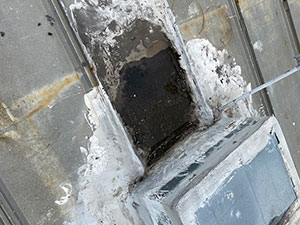
A commercial roof leak does not tell you, by itself, whether the repair will be small or whether moisture has spread beyond the visible symptom. The useful question is what the inspection finds at seams, penetrations, flashing, drainage areas, and within the roof assembly. Outdo Commercial Roofing serves commercial properties across Southern Indiana and provides leak detection, repairs, maintenance, and broader roofing solutions. Call (574) 536-2823 to discuss a suspected commercial roof leak.
Commercial Roof Leak Repair Starts With Evidence
Interior staining, a drip, a lifted seam, or damaged flashing is a reason to investigate, not a complete diagnosis. Water can move through insulation, along decking, or around penetrations before it appears inside the building. A professional assessment should connect the visible symptom to conditions found on the roof and determine whether the surrounding materials remain serviceable.
Outdo Commercial Roofing’s commercial roof inspection article explains why documented inspections help building owners catch developing problems before they become harder to manage.
Localized Defect or Broader Roof Problem?
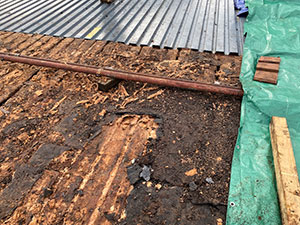
The table below shows how common symptoms should guide the inspection without treating any single sign as proof of hidden damage.
| Visible Symptom | What the Inspection Should Check | When a Localized Repair May Fit | When Broader Assessment Is Needed |
|---|---|---|---|
| Interior stain near a vent, pipe, or rooftop unit | Penetration seals, curb flashing, nearby membrane, and the moisture path above the interior stain | A single confirmed defect with dry, serviceable surrounding materials | Moisture extends beyond the penetration or several nearby details show failure |
| Open or lifted membrane seam | The affected seam plus adjacent seams for adhesion loss, contamination, or repeated separation | One isolated seam defect with sound surrounding membrane | Multiple seams show similar failure or moisture has spread beneath the membrane |
| Damaged edge or penetration flashing | Fasteners, laps, sealants, transitions, and similar flashing details elsewhere on the roof | Damage is confined to a defined flashing section | Repeated flashing deterioration suggests a larger condition or installation issue |
| Recurring stains, soft areas, or suspected wet insulation | Moisture extent using appropriate survey methods and, when necessary, confirmatory testing | Only after the affected area is clearly defined and the surrounding assembly is suitable | The extent is uncertain, widespread, recurring, or involves deteriorated insulation or decking |
NRCA guidance recognizes visual inspection, nondestructive moisture surveys, and core sampling as different tools for evaluating commercial roofs. Moisture-survey readings can be influenced by roof construction and other conditions, so suspect areas may need verification before the repair scope is finalized.
What a Localized Repair Should Cover
A localized repair makes sense when the defect is clearly identified and the surrounding roof remains in suitable condition. Examples can include repairing a small membrane puncture, resealing a penetration, correcting an isolated seam, or replacing a limited flashing section. The repair should address the confirmed entry point rather than simply cover the interior location where water became visible.
For another example of when focused repair can be appropriate, see Outdo’s flat roof repair guidance for Evansville. It distinguishes localized punctures, seam separation, and flashing failures from repeated leaks and more extensive deterioration.
What a Commercial Roof Leak Repair Quote Should Include
A clear repair quote should identify the defect being addressed, the roof area involved, preparation requirements, repair materials, and important exclusions. It should also explain whether the work is intended as a temporary measure or a permanent repair within the existing roof system.
Access planning belongs in the scope as well. Commercial roofs may have restricted access, active loading areas, rooftop equipment, occupied spaces, or other conditions that affect crew movement and staging. The contractor should account for safe access and building operations without turning the owner into the person responsible for diagnosing or walking the roof.
If concealed conditions could change the scope, the quote should explain how additional findings will be documented and approved before extra work proceeds.
When the Roof Needs More Than Another Patch
A broader assessment is appropriate when leaks recur after repair, several roof areas show similar failures, moisture extent cannot be defined from the surface, or the surrounding membrane, insulation, or deck shows deterioration. In those situations, another isolated patch may stop one entry point without addressing the larger condition.
Outdo’s maintenance and repairs service covers inspection, repair, and ongoing maintenance needs. The next step should be based on documented roof conditions, not an assumption that every leak requires replacement or that every visible defect can be solved with a small patch.
Commercial Roof Leak Repair in Southern Indiana
The most useful commercial roof leak repair starts by defining the defect and the moisture extent before deciding how much work is needed. For commercial properties across Southern Indiana, Outdo Commercial Roofing can evaluate the roof, identify repairable localized defects, and explain when the findings justify a broader assessment. Call (574) 536-2823 to discuss a leak or repair concern.
Frequently Asked Questions
Can a ceiling stain show where the roof is leaking?
It can help identify the affected interior area, but it does not prove the roof entry point or the extent of hidden moisture. The roof and surrounding assembly still need to be evaluated.
When is a commercial roof leak usually suitable for a localized repair?
A localized repair may fit when one defect is confirmed and the surrounding membrane, insulation, flashing, and deck remain serviceable.
What should be included in a commercial roof leak repair quote?
The quote should identify the defect, repair area, preparation, materials, exclusions, access assumptions, and how additional concealed conditions will be handled.
When should a leak lead to a broader roof assessment?
Recurring leaks, multiple failing areas, uncertain moisture extent, or deteriorated insulation or decking are reasons to evaluate more than the visible defect before finalizing a repair scope.